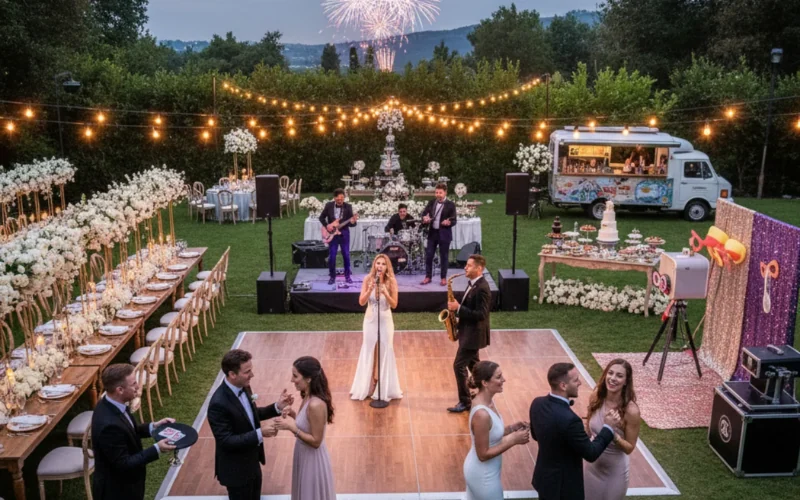
Lighting is the last thing most couples think about and the first thing their guests notice. Nobody walks into a courtyard at ten at night and says the uplighting is well balanced. They say it looks beautiful, and what they are actually reacting to is the lighting.
On the Costa del Sol it matters more than it does at home, for one simple reason. Almost every wedding here happens outdoors, and outdoors has no ceiling to bounce light off and no light switch. Whatever you hang, stand up or plug in is the entire lighting design.
We plan and run weddings across this coast every season and we are on site while the sun goes down. This is what we have learned about lighting a wedding here, what the options actually cost, and the practical limits that decide what is possible at your venue.
When it actually gets dark
This is where lighting planning starts, and couples planning from the UK almost always get it wrong, because Spain sits on Central European Time while being far to the west. Evenings run remarkably late in summer.
Approximate sunset times on the Costa del Sol, which are worth checking against your exact date:
- June and July: around 21:30 to 21:45, with usable light until nearly 22:15
- August: around 21:00, dropping steadily through the month
- September: around 20:20 at the start, 19:45 by the end
- October: around 19:30, falling to about 18:30 once the clocks change late in the month
- May: around 21:20
- December and January: around 18:00 to 18:20
The practical consequence is that a June wedding will not see darkness until the meal is finished, so your lighting has to work as decoration in daylight before it works as lighting at all. A late September or October wedding gets genuine darkness during dinner, which is when lighting does its most dramatic work. If the atmosphere of a candlelit dinner matters to you, that alone is a reason to look at the autumn.
The main options, and what each one is for
Festoon and string lighting
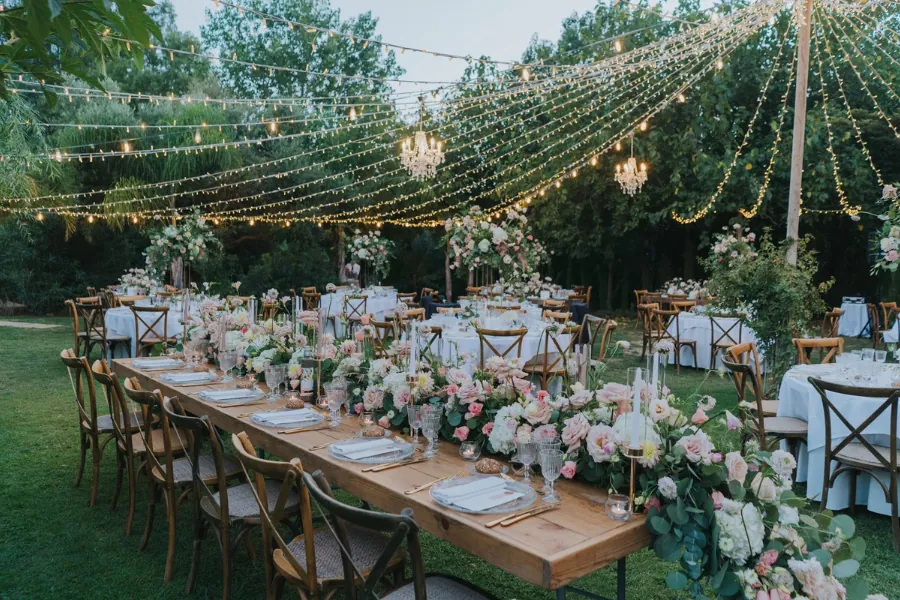
Warm bulbs strung overhead across a terrace, a garden or a dancefloor. This is the workhorse of Mediterranean wedding lighting and the single best value item on the list. It defines a space that has no walls, it photographs beautifully, and it flatters everyone underneath it. If you only do one thing, do this.
Fairy lights and canopies
Finer, denser and more romantic than festoon, and the right choice under a pergola, through olive trees or across a covered dining area. Denser canopies take longer to install, so they cost more in labour than in kit.
Hanging lampshades and pendants
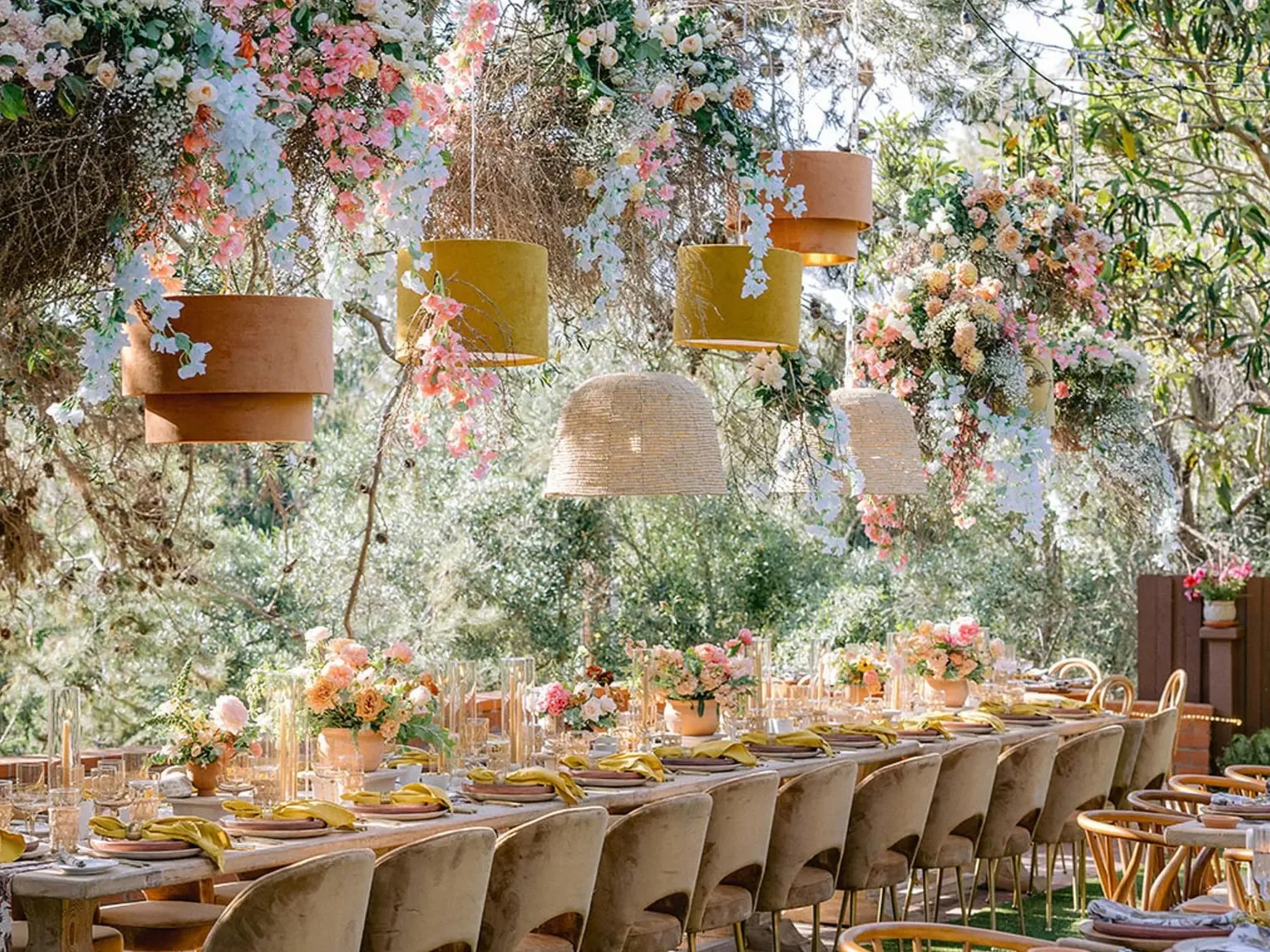
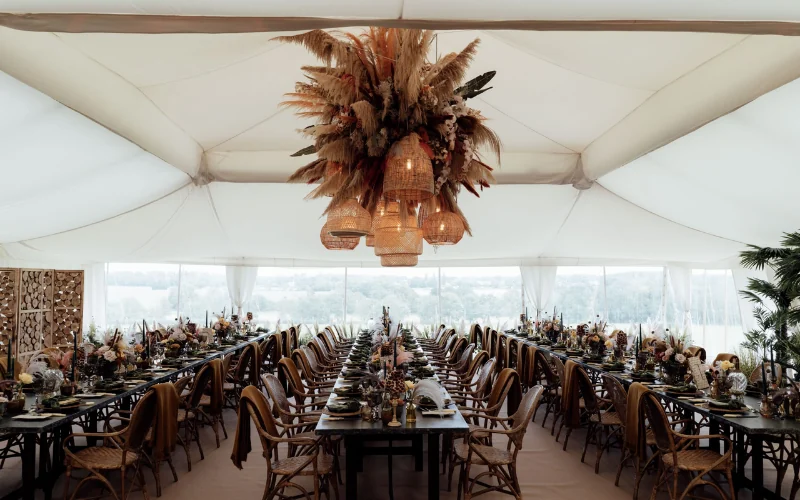
This is what most couples mean when they talk about wedding lamps, and it is the boldest thing you can do overhead. Fabric or velvet shades, rattan pendants and oversized drums suspended above a long table, usually hung alongside a floral installation so the two read as one piece.
It photographs like nothing else, and it is the most demanding option on this list. Shades are bulky, they catch the wind, and they need a proper rig rather than a wire strung between two trees. That means either a structure already in place, a pergola or mature trees strong enough to take the load, or a truss brought in. It also means an install measured in a day rather than an afternoon.
Worth knowing: shades read as decoration in daylight and as light sources after dark, which makes them one of the few options that earns its place across the whole day at a summer wedding. If you are marrying in June or July, when nothing is dark until after dinner, that matters more than it sounds.
Budget €900 to €2,500 depending on the number of shades, the rigging required and whether they are hung with florals.
Lanterns, hurricanes and candlelight
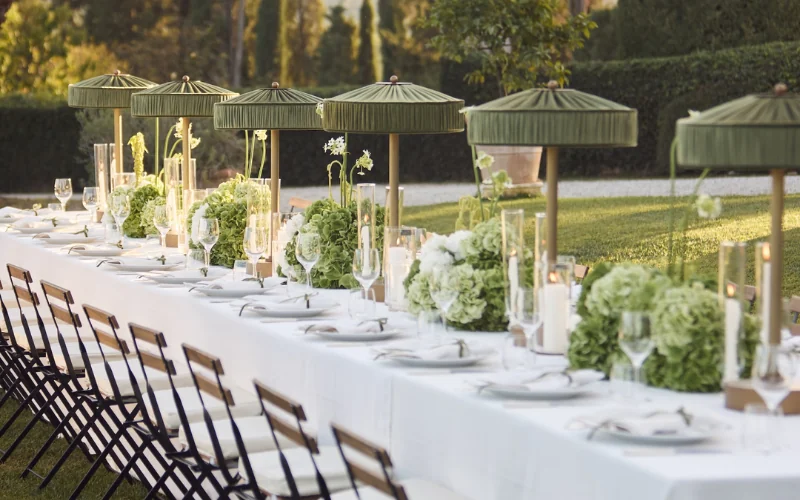
Nothing else produces that quality of low, moving light. Candles down the length of a table, lanterns lining an aisle or a path, hurricanes on steps. Bear in mind the coastal breeze, which puts most open flames out, so hurricane glass or LED alternatives are usually the practical answer outdoors.
Uplighting and architectural lighting
Uplighters placed against a wall, a facade, a row of cypress trees or the underside of a pergola. This is what makes a venue look designed rather than simply lit, and it is the option couples most often skip and most often regret when they see the photographs.
Neon signs and statement pieces
A name or a phrase in neon behind the bar or beside a flower wall. Popular, effective for photographs, and worth siting where people will actually stand rather than in a corner.
Dancefloor and effect lighting
Distinct from decorative lighting and usually supplied by your DJ rather than your lighting company. Agree who is providing what, because we have seen couples pay twice for the same rig.
Where lighting earns its money
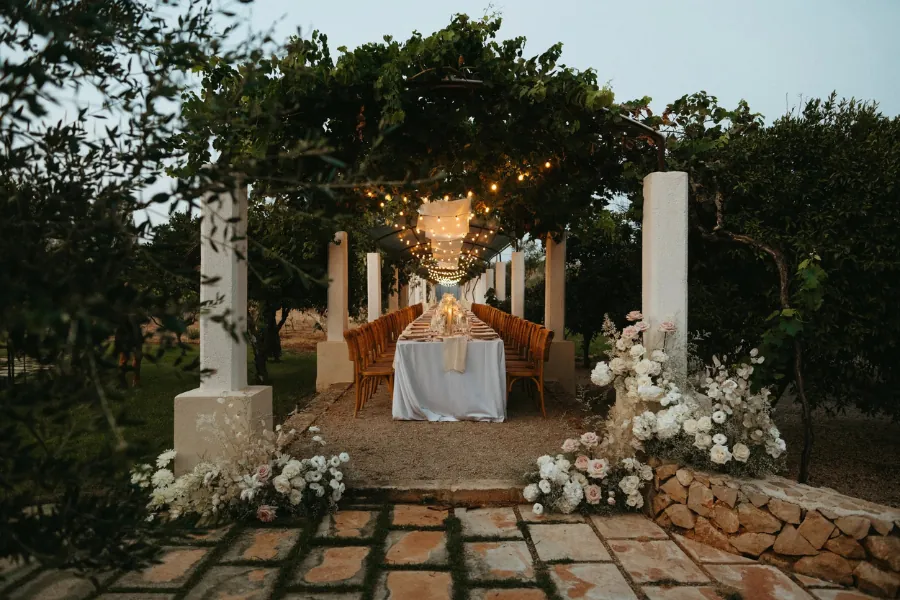
Four places, in order of impact.
- Over the dining tables, because that is where guests spend the longest and where the photographs of your reception are taken
- On the walk between spaces, since a lit path from ceremony to reception is both safety and theatre, and unlit ground on an uneven finca is a genuine hazard in heels
- On the building itself, because a well uplit facade or a lit tree line gives every wide photograph a backdrop instead of a black void, which is worth discussing with your photographer and videographer before anything is rigged
- Around the bar and the dancefloor, where the party actually happens
What we would not spend on: lighting areas guests never enter, and anything so bright it flattens the atmosphere. Wedding lighting should be warm and low. Cool white light makes an outdoor space look like a car park.
The practical limits at Costa del Sol venues
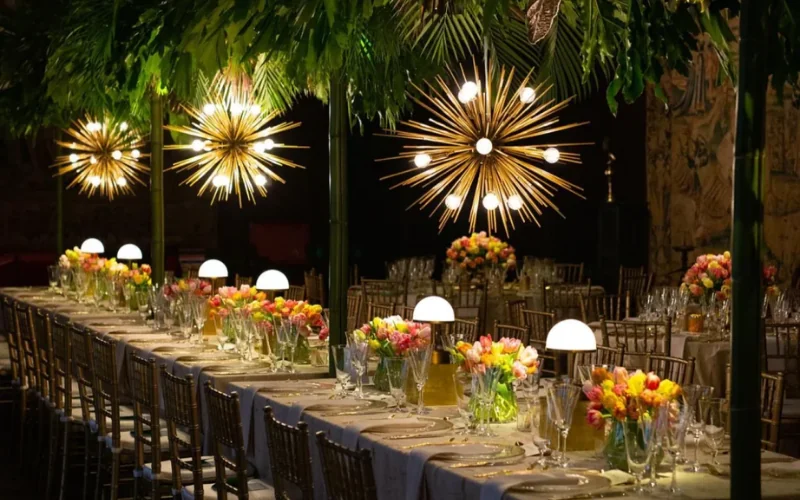
This is the part that decides what is genuinely possible, and it is venue specific rather than general.
Power. Lighting draws less than a DJ rig but more than couples expect once you add booths, catering equipment and a bar. Villa and finca weddings frequently cannot run everything at once. Either the supply is checked properly in advance or you hire a generator, and a generator needs siting where nobody can hear it. Some venues are built for it, and Casa de la Era near Marbella has three phase power and a rooftop DJ booth, which removes the problem entirely.
Fixings. Festoon has to attach to something. Mature trees, existing posts and pergolas are ideal, and drilling into historic walls is usually forbidden. Historic settings such as Castillo de Monda are a good example, beautiful to light and strictly limited in what you may attach anything to. Where there is nothing to fix to, you are into weighted uprights, which are perfectly good but add cost and take up floor space. Always ask what a venue permits before you design a scheme around it.
Wind. The afternoon onshore breeze on this coast lifts anything light. Paper lanterns and unweighted shades move constantly, and candles need glass. Anything suspended needs proper tensioning rather than being strung loosely.
Fire policy. Many Andalusian venues restrict open flames through the dry summer months, and some ban them outright. If candlelight is central to your scheme, confirm it in writing early, and have LED pillars as the fallback.
Curfews. Noise limits are municipal and vary between venues twenty minutes apart, which affects how long your lighting is actually working for. It is worth knowing before you invest in an elaborate scheme for a party that stops at midnight.
Our wedding on the Costa del Sol was everything we had hoped it would be, relaxed, elegant and full of joy.
What wedding lighting costs on the Costa del Sol
Indicative ranges for the region, including installation and collection.
- Festoon lighting over a terrace or dining area: €400 to €1,200 depending on the run and the fixings needed
- Fairy light canopy: €600 to €1,800, driven more by installation time than by kit
- Uplighting: €25 to €45 per unit, with most schemes using eight to twenty
- Lanterns and hurricanes: €8 to €20 per piece to hire
- Candles and holders across tables: €150 to €600 depending on scale
- Hanging lampshades and pendants: €900 to €2,500 depending on the number of shades and the rigging needed
- Neon sign hire: €200 to €450, or more to have one made and keep it
- Generator hire where needed: €200 to €500 for the day
A typical scheme for a hundred guests at a villa comes in somewhere between €1,500 and €3,500. These are guide figures that move with season, access and how much rigging a site needs. We build the real numbers into your budget when we source your suppliers, and you can see how it sits alongside everything else on our wedding packages and prices page.
Getting the timing right
Lighting installation is slower than couples expect. A festoon run over a dining terrace takes a team two to four hours, and a dense fairy light canopy can take most of a day. That has to fit around the caterers, the florists and the furniture, which is exactly the sort of scheduling our on-the-day coordination team exists to manage.
Two things are worth insisting on. Ask for the lighting to be switched on and checked before your guests arrive, in daylight, so a failed circuit is found while there is still time. And agree who is taking it down and when, because collection the following morning is normal and collection at one in the morning is not, and venues have strong views either way.
Booking
Lighting suppliers on this coast are busy from May to October, and the good ones hold a limited number of installs per weekend rather than per day. Six to nine months ahead is comfortable, and twelve for a peak summer Saturday. It is one of the few elements you can book relatively late, but late means fewer options rather than none.
If you are still choosing a venue, it is worth walking it in the evening if you possibly can, or asking to see photographs taken after dark. A garden that looks glorious at four in the afternoon can be a very different proposition at ten at night, and that is precisely what lighting has to solve. Estates like Finca Monasterio and Huerta del Conde already have established festoon and canopy installations, which is worth knowing before you budget for a scheme from scratch.
We source, brief and manage lighting alongside every other supplier as part of our wedding planning service. Have a look at our Costa del Sol wedding venues, or get in touch and we will talk through what your setting can take.